How iDOO Bridges Legacy Infrastructure and AI in Industry

Timo
Brenningmeyer
COO
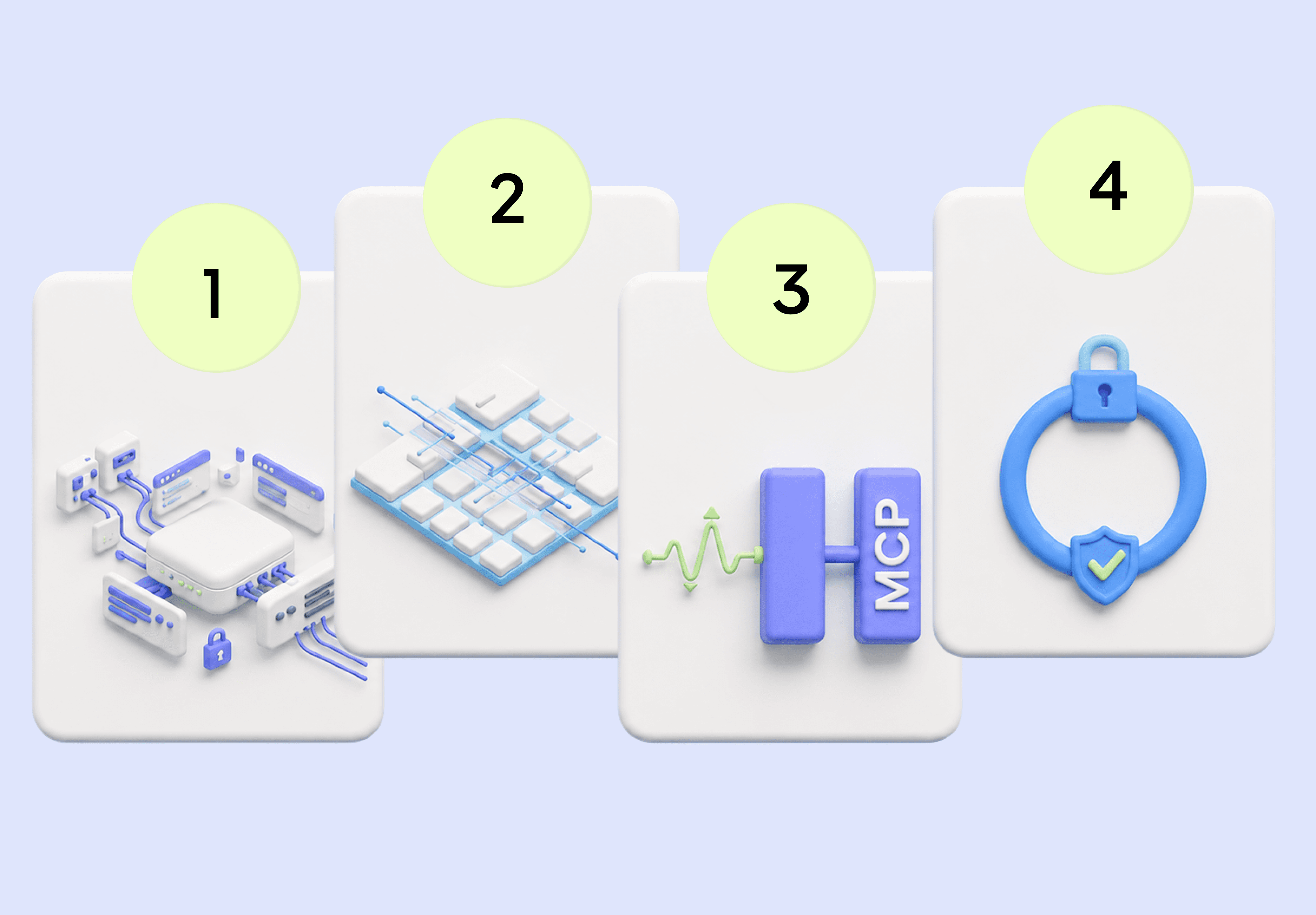
From fieldbus and PLC registers to MCP and grounded AI agents: a four-step architecture for turning brownfield assets into safe, developer-grade Industrial AI.
Summary: Most Industrial AI projects fail not because of weak models, but because they overlook two critical factors: human operators and brownfield infrastructure. Many projects remain pilots without measurable value because they do not provide actionable guidance for technicians or connect modern AI with existing operational technology. iDOO’s architecture is engineered to turn rigid legacy OT into clean software interfaces, align noisy telemetry into a Unified Namespace and make it accessible to AI agents through the Model Context Protocol (MCP). This approach enables multimodal, grounded reasoning by integrating live machine data with unstructured sources such as manuals and voice logs. The result is safe, deterministic guidance for technicians, faster fault diagnosis, less downtime and lower integration and cloud costs.
Before we talk about microservices and code, we need to talk about why we are building this at all. The industry faces a stark reality: repeated studies reveal that approximately 70% of Industrial AI and digitization projects fail to generate measurable value. Many remain stuck in the pilot stage: they may prove that a model works, but fail to deliver measurable value for technicians or production operations.
The problem is not the quality of the models. Most Industrial AI solutions are hindered by two critical blind spots. First, they neglect the human element. They present raw anomalies or abstract error codes to technicians and operators on the shop floor. This creates an actionability gap and overwhelms users. Second, they fail to bridge the technological gap between modern, multimodal LLMs and the rigid, isolated environment of legacy operational technology in brownfield factories. Production environments were not built for modern AI. They are shaped by rigid, isolated legacy infrastructure, while technicians need clear and actionable guidance. iDOO closes this gap by connecting legacy infrastructure with modern AI. The goal is not to use AI for its own sake, but to apply it where it creates measurable value for technicians and production operations: less downtime, faster fault diagnosis and lower integration and cloud costs.
The iDOO architecture makes Industrial AI deployable on legacy infrastructure. Its goal is twofold: turn untouchable brownfield iron into abstract software interfaces, and ground advanced AI agents in deterministic shop-floor facts. We engineered this as a four-step bridge, starting at the physical asset level and ending in safe, actionable intelligence for people in production environments, including plastics manufacturing.
Step 1: Strict abstraction at the physical boundary
Anyone who has worked on a shop floor in a brownfield factory understands the complexity of the environment. Severe legacy lock-in dominates the landscape. This includes proprietary fieldbus protocols, closed ecosystems such as outdated Siemens S7 variants, and Modbus over RS-485 lines that lack any native concept of an API or web compatibility. For developers and manufacturing IT teams, creating custom ingestion pipelines for every machine variant eliminates any chance of scalable Industrial AI deployment.
Our answer is strict abstraction at the physical boundary. Rather than modifying fragile PLC code, which is costly and poses significant risks in production, we deploy a ruggedized Industrial Edge Gateway to terminate all physical connections. Within this gateway, integration logic is decoupled. We run containerized Protocol Adapters as independent microservices. Each adapter polls low-level registers and extracts raw bytes from the PLC or fieldbus. It converts this data into a clean, unsiloed software layer at the edge. Brownfield assets are transformed into addressable, versioned interfaces without touching a single ladder rung. This is the foundation for Industrial AI in legacy manufacturing environments.
Step 2: Taming telemetry and enforcing structural meaning
Once the physical layer is abstracted, the next challenge is the telemetry flood and the lack of structure. High-frequency sensors produce vast amounts of raw data, often riddled with clock jitter and variable sample rates. If left unmanaged, this data overload strains network bandwidth and drives up cloud ingestion costs. Even more critically, uncontextualized time-series metrics offer no value to an Industrial AI system. A temperature spike is irrelevant unless the system can pinpoint the exact component, machine and production line it pertains to.
To solve this, our protocol adapters serve dual functions. At the edge, they execute inline filtering, noise reduction and sample-rate alignment directly within the gateway. The refined data streams are then connected to our local Historian API. Here, we enforce a strict ISA‑95‑aligned hierarchy and automatically map incoming metrics into a Unified Namespace (UNS). The outcome, as defined in the JSON schema, is a polished, event-driven time-series database where every data point is synchronized, typed and structurally contextualized. This UNS layer provides the foundation on which the Industrial AI layer can reason without guessing, particularly in complex environments like the plastics industry. Data is filtered, normalized and contextualized at the edge before it is published to the UNS. This helps reduce unnecessary cloud ingestion and can provide faster access to relevant machine data.
Step 3: AI integration via Model Context Protocol (MCP)
Historically, integrating large language models into operational environments has presented significant interoperability challenges. Foundational models lack any native understanding of historian APIs or PLC registers and often process raw time-series data as opaque text blobs. If you start wiring custom endpoints for every query, your codebase degenerates into a tangle of one-off data-wrangling scripts. Meanwhile, unstructured knowledge such as operator voice transcripts, maintenance PDFs and shift logs remains completely disconnected from live machine metrics.
We solve this bottleneck by implementing the Model Context Protocol (MCP) directly on top of our structured Historian. MCP acts as a standardized, bilateral gateway between the reasoning core and the data plane. The AI agent does not need a bespoke database connector. It utilizes native MCP tool calls to retrieve precise telemetry windows or events based on semantic requests. This approach enables genuine multimodal grounding. The agent can process unstructured input, such as a technician’s verbal log entry, and instantly access the corresponding verified machine states via MCP. Live telemetry and static knowledge are unified within a single reasoning loop, eliminating the need for custom integration code for each scenario. This is a key enabler for Industrial AI in plastics manufacturing and other brownfield industries.
Step 4: Closed-loop, schema‑guarded agent workflow
The final step involves converting this integrated data into safe, actionable intelligence for human operators. Standard generative AI, if left unregulated, poses inherent risks in industrial environments. Raw anomaly alerts or abstract error codes offer zero debugging value to a technician. Even more concerning, an ungrounded model may generate fabricated repair instructions. On the factory floor, this is not merely a software flaw. It represents a tangible safety risk.
We address this by wrapping the multimodal core in a closed-loop, schema-driven agent workflow. During runtime, the sequence looks like this: when a technician asks the UI, “Spindle 3 is overheating, what should I check?”, the agent does not guess. It immediately executes an MCP tool call to retrieve live metrics from the UNS repository for that specific spindle. Simultaneously, it accesses a localized vector database to obtain relevant context from verified OEM manuals and historical service tickets. We then enforce strict schema guardrails: the agent must cross-reference live telemetry against documented tolerances and procedural constraints before generating a response.
The result for the operator is a deterministic, step-by-step resolution path. It is fully supported by real-time data and explicit citations to source documents. There is no free-form speculation, no ambiguous anomaly. There is only grounded, reproducible guidance that fulfills both operational and safety standards in manufacturing plants. This supports faster fault diagnosis and can help reduce downtime.
This four-step bridge encompasses edge abstraction, telemetry structuring, MCP-based integration and closed-loop, schema-guarded agents. This is how iDOO transforms brownfield infrastructure into secure, developer-grade Industrial AI. It is not about “adding AI” on top of legacy plants. It is about engineering a stack where legacy iron and advanced models can finally speak the same language, in a way that makes sense to the people who rely on them every day, whether in plastics factories in Germany, across Europe or in global manufacturing networks.
The practical outcome is a production-ready foundation for faster fault diagnosis, less downtime and lower integration and cloud costs.
If this topic resonates with you and you are looking for a practical, step-by-step approach to making Industrial AI work in real brownfield production environments, we recommend the latest WeAreDevelopers talk by Timo, COO at iDOO, and Freya Menzel, Product Lead at iDOO. In their session, they take a clear, reality‑focused look at what is happening on today’s shop floors:
Why most Industrial AI and digitization initiatives fail long before the model is deployed
Where the real bottlenecks lie: legacy OT, noisy and fragmented telemetry, and overwhelmed human operators
How iDOO’s edge abstraction, Unified Namespace and MCP‑based tooling turn “untouchable” brownfield assets into safe, developer‑grade interfaces for AI
How grounded, schema‑guarded AI agents can turn everyday production issues into reproducible, deterministic guidance for plastics manufacturers
If you are evaluating a specific brownfield use case, we also invite you to start a conversation with us and review how this approach could support your production environment. Schedule a demo with our team today.
About
Timo
Brenningmeyer
Timo ist Chief Operating Officer (COO) der iDOO GmbH und gehört seit 2024 als einer der ersten Mitarbeitenden zum Unternehmen. Mit einem starken Hintergrund in Technologie, Entwicklung, Projektmanagement und der Leitung von F&E treibt er maßgeblich die operative Ausrichtung sowie das internationale Wachstum von iDOO voran. Timo spielt eine zentrale Rolle beim Ausbau der internationalen Präsenz – insbesondere in Nordamerika und verantwortet die Weiterentwicklung und Skalierung des Geschäfts auf globaler Ebene.